Mesh Quality in FEA: How to Actually Trust Your Results
Element type, aspect ratio, skewness and the convergence study. We assess whether a finite-element model's results reflect reality, through the lens of mesh quality.
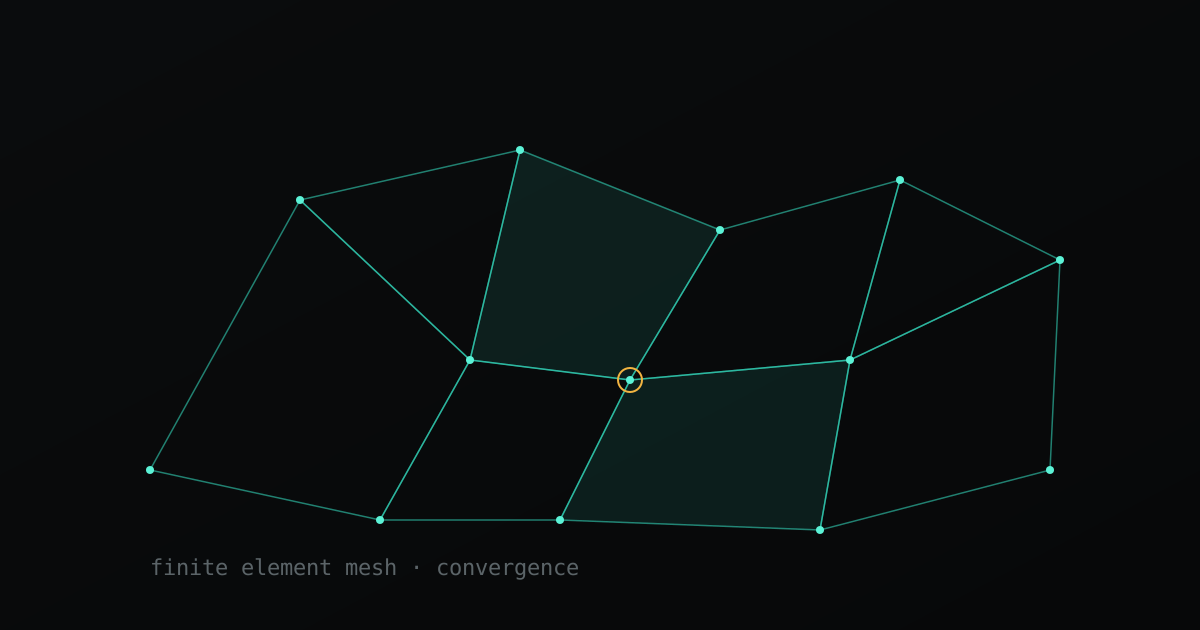
FEA results are colorful and persuasive — but a colorful stress plot is not the same as a correct stress plot. The reliability of your results depends heavily on mesh quality. This article walks through the metrics an engineer should check and the classic convergence study.
Choosing the Element Type#
The first decision is element type. Tetrahedral elements conform easily to complex geometry, while hexahedral elements usually give higher accuracy for the same number of degrees of freedom. The difference between first-order (linear) and second-order (parabolic) elements is critical too: linear tets can behave far too stiffly under bending.
Rule of thumb
For a bending-dominated part, prefer second-order elements. Having at least two elements through the thickness is a good starting point for capturing bending stresses.
Mesh Quality Metrics#
Before sending the model to the solver, check these metrics:
- Aspect ratio — the ratio between an element's longest and shortest edge. Ideally close to 1.
- Skewness — how far the element deviates from its ideal shape.
- Jacobian — a numerical measure of element distortion; a negative Jacobian is unacceptable.
- Warpage — out-of-plane deviation in shell elements.
Even a single bad element can corrupt the results locally — especially in regions where you expect stress concentration, mesh quality must be checked carefully.
The Convergence Study#
The way to prove a result is mesh-independent is a mesh convergence study. You solve the same problem with progressively finer meshes and plot the quantity of interest (for example, peak von Mises stress) against mesh density. When the curve flattens to a horizontal asymptote, the result has become mesh-independent.
Beware of singularities
At sharp re-entrant corners, stress diverges toward infinity as the mesh is refined. This is a mathematical singularity, not a physical one. Using the peak stress value directly in these regions is misleading.
Video: Mesh Convergence, Visually#
In the short explainer below I summarize the logic of a convergence study visually.
Summary#
A good FEA engineer trusts the mesh behind the results, not the results themselves. Choose the element type deliberately, check the quality metrics, and run a convergence study for every serious analysis. These three habits dramatically increase the chance that your model reflects reality.