What Is Modal Analysis? A Practical Introduction for Engineers
Natural frequencies, mode shapes and damping ratios: a hands-on guide to the core ideas behind modal analysis, why it matters, and how it is used in both CAE and physical testing.
The "ring" you hear when you tap a structure is really its dynamic identity. Every bridge, every gearbox housing, every aircraft wing prefers to vibrate at certain frequencies. Modal analysis is the discipline that uncovers exactly those preferences.
This article covers modal analysis from the ground up: the core concepts, the math behind them, the numerical (CAE) approach, and the physical test side. The goal is to give both students and practicing engineers a clear answer to the "why" and the "how".
Three Fundamental Quantities#
Everything modal analysis produces revolves around three ideas:
- Natural frequencies — the frequencies at which a structure prefers to vibrate with no external forcing.
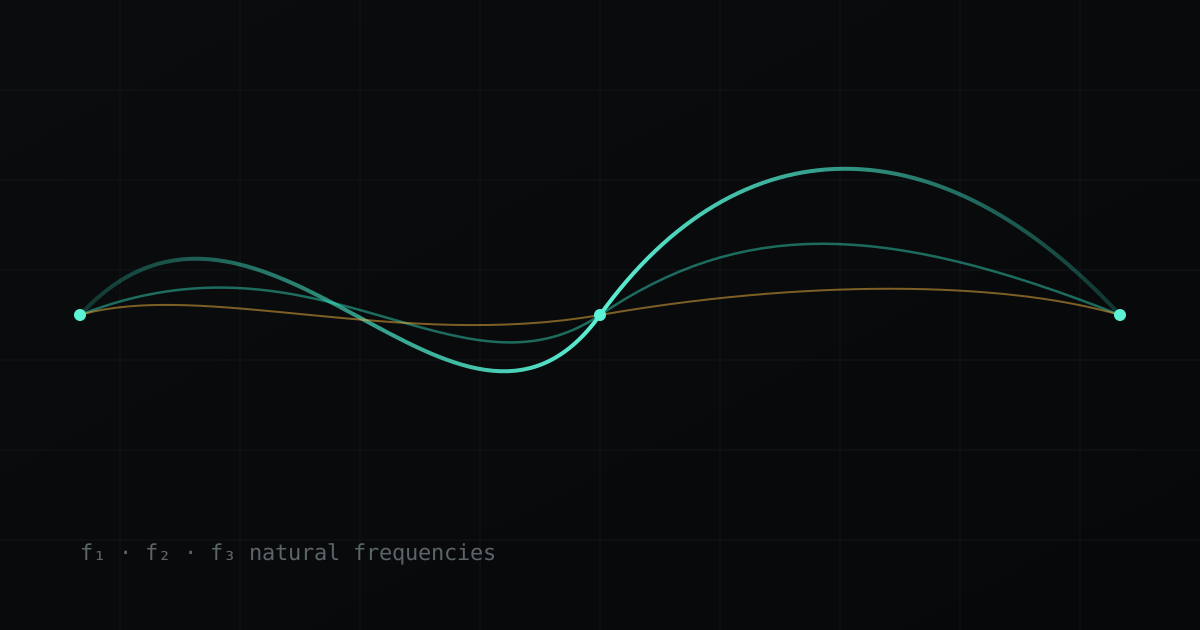
- Mode shapes — the characteristic deformation pattern the structure takes at each natural frequency.
- Damping ratios — how quickly the vibration energy dies out.
Why does it matter?
If the frequency of an excitation force approaches one of the structure's natural frequencies, resonance occurs and vibration amplitudes can grow to dangerous levels. Modal analysis lets us predict that overlap while the design is still on the screen.
The Math Behind It#
For undamped free vibration, the equation of motion is:
[M]{ẍ} + [K]{x} = {0}
Here [M] is the mass matrix and [K] is the stiffness matrix. Assuming a harmonic solution turns the problem into an eigenvalue problem:
([K] − ω²[M]){φ} = {0}
The eigenvalues ω² give the natural frequencies and the eigenvectors {φ} give the mode shapes. In practice we never solve this by hand; finite-element solvers (Nastran, Simcenter 3D) handle tens of thousands of degrees of freedom in seconds.
The Numerical Side: Modal Analysis with CAE#
In a finite-element model, modal analysis typically follows these steps:
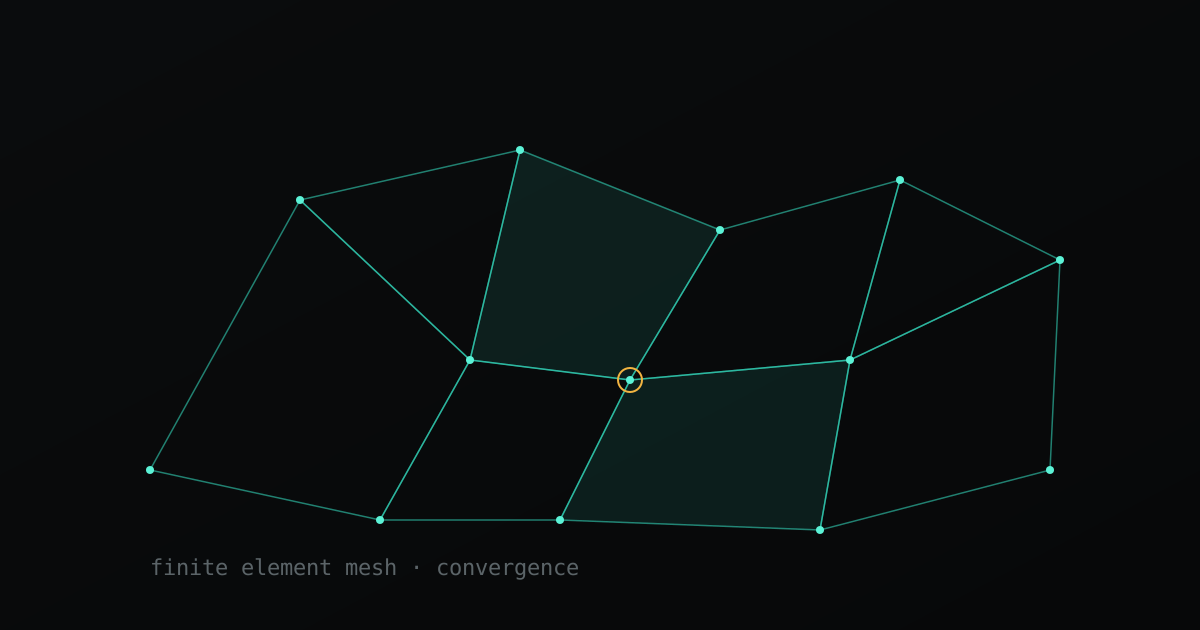
- Discretize the geometry with a mesh.
- Define material properties (density, Young's modulus).
- Apply boundary conditions — free-free or constrained?
- Run the normal-modes solution in the solver.
- Inspect natural frequencies and mode shapes.
Mind the boundary conditions
In a free-free analysis the first six modes appear near zero frequency as "rigid-body modes". Do not confuse these with the structural modes.
The Physical Side: Experimental Modal Analysis (EMA)#
No matter how good a numerical model is, it needs validation. In experimental modal analysis we excite the structure with a controlled force (usually a modal hammer or a shaker) and measure its response with accelerometers. From the frequency response functions (FRFs) we extract natural frequencies, mode shapes and damping.
Comparing numerical and experimental results is called test-analysis correlation, and the MAC (Modal Assurance Criterion) is the standard metric for it.
Where Is It Used?#
Modal analysis plays a critical role in automotive NVH, aerospace structures, rotating machinery, civil engineering and even electronic board design. From resonance-driven fatigue cracks to cabin noise, modal behavior sits at the root of many problems.
Summary#
Modal analysis extracts the dynamic fingerprint of a structure. Once you understand the trio of natural frequencies, mode shapes and damping, you can anticipate resonance problems during design and confidently validate your model against test data. In upcoming articles we will walk through a step-by-step modal setup in Simcenter 3D and an FRF measurement.